Drum transcription
Tony Williams — Seven Steps Solos (Chronological)
Three Tony Williams solos on Miles Davis' "Seven Steps to Heaven" (April '63 → February '64) tracing his bebop-to-post-bop evolution.
How to practice this
Over a relatively short period of time, one can observe the way the musical language of Anthony Williams' solo improvisations evolved from the bebop style into something new and other — the avant-garde language of post-bop. These transcriptions document this evolution via three solos Williams played on different versions of the Victor Feldman piece "Seven Steps To Heaven", recorded during the period from April of 1963 through February of 1964.
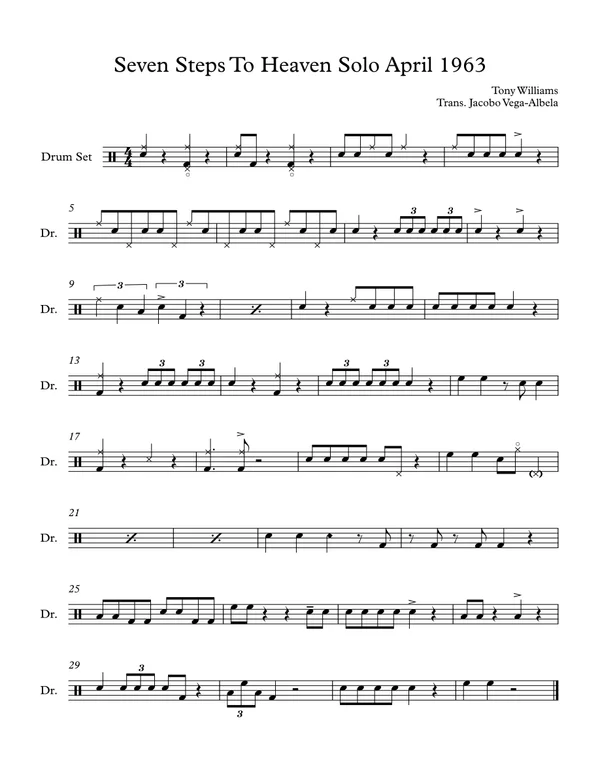
The document begins with the solo he played on the version of "Seven Steps" found on the Miles Davis record "Seven Steps to Heaven" (1963). This solo fits neatly over the 32 bar form of the tune and is made up of typical bebop language reminiscent in many ways of the styles of Max Roach, Art Blakey, and Philly Joe Jones, primary influences cited by Williams in an interview with Downbeat magazine.
This April '63 solo presents us with a number of musical fragments, phrasing concepts, pathways of motion, orchestrations, and approaches that seem to evolve naturally and logically into the content found in the later solos.
For all the apparent similarities between these solos, there are also significant differences that mark a major stylistic shift in Williams' playing. Though the term "post-bop" is a rather vague one, it is nonetheless important to our discussion, and should be briefly examined for the sake of clarity.
In his book Miles Smiles, and the Invention of Post Bop, Jeremy Yudkin describes the "adoption of a kind of elastic form that can stretch to accommodate creative improvisation..., employment of uncommon time signatures..., [a] rhythmically more varied approach to the creation of solo lines... [and] a multifaceted juxtaposition of momentum and stasis" as key traits of the "post-bop" style that the Miles Davis Quintet of the mid 1960s was developing. Though these solos were recorded years earlier than the Miles Smiles recordings Yudkin is describing, we can see all of these elements in the later Williams solos (June '63 and February '64).
Elastic Form
Though the April '63 solo fits neatly over the 32 bar form of Seven Steps To Heaven, the June '63 and February '64 solos do not. The June '63 solo is 63 bars long, and the February '64 solo seems to resist being confined by bar lines almost entirely, as the latter half of the solo is in free time. When transcribing the '64 solo I chose to use barlines only to indicate the beginnings and endings of musical ideas in the latter half. Williams' de-prioritization of strict adherence to the original form of the piece allows him a much greater degree of freedom of expression, and this freedom seems to yield much more fluid and directional phrasing.
Rhythmic Variation
In the '64 solo, Williams uses a number of odd rhythmic groupings including fives, nines, and tens. For example, in mm. 12-15 we see nine-note cross rhythms (indicated by the beaming and grouped 4+5), in mm. 23-24 we see a five-note cross rhythm made up of quarter note triplets, and in mm. 34 we see a repeated ten-note phrase made up of eighth notes. Additionally, in the June '63 solo we see the use of unusual tuplets (in this case quintuplets) in mm. 46-47, and changing meter as in the bar of 5/4, and the later bar of 2/4.
Momentum and Stasis
Long repeated gestures, like the quarter note triplet figures in the introduction of the February '64 solo establish a kind of static feeling and give the listener something to latch on to, while the longer, less repetitive lines create momentum. The juxtaposition of highly repetitive and rapidly changing material, as well as Williams' use of devices like ritardandi, accelerandi, and rubato phrasing create a kind of drama and intrigue in this later improvisation that is absent from the April '63 solo.
Anthony Williams was a true musical visionary, and unquestionably one of the most important figures in the history of the drumset. As a major pioneer not only in the field of post-bop, but also jazz-rock fusion, the effect his contributions to the art of drumming continue to have to this day is hard to overstate. I hope this study of Williams' development over a very short window of time might help to illuminate some of the ways in which Williams used the things he learned from the masters of bop drumming who came before him to create his own personal musical language, and to push the artform forward in new directions.
Some food for thought
Where does one draw the line between bebop and post-bop? Would the creation of such a delineation even provide any meaningful insight? And perhaps most importantly, how might today's musicians hope to learn not just from the specific content found in Williams' playing, but from the process that yielded the masterful synthesis of his many different influences into a conversational musical voice with which Williams could freely express himself?
A note to the practicing drummer
If you want to learn the '64 solo (recorded on "Four & More" by Miles Davis) you really must listen to the solo many times, and get it into your ear. The notation is not sufficient to convey the depth of what Tony was doing. Try to play along and work out your own interpretation.